BREATHWORK
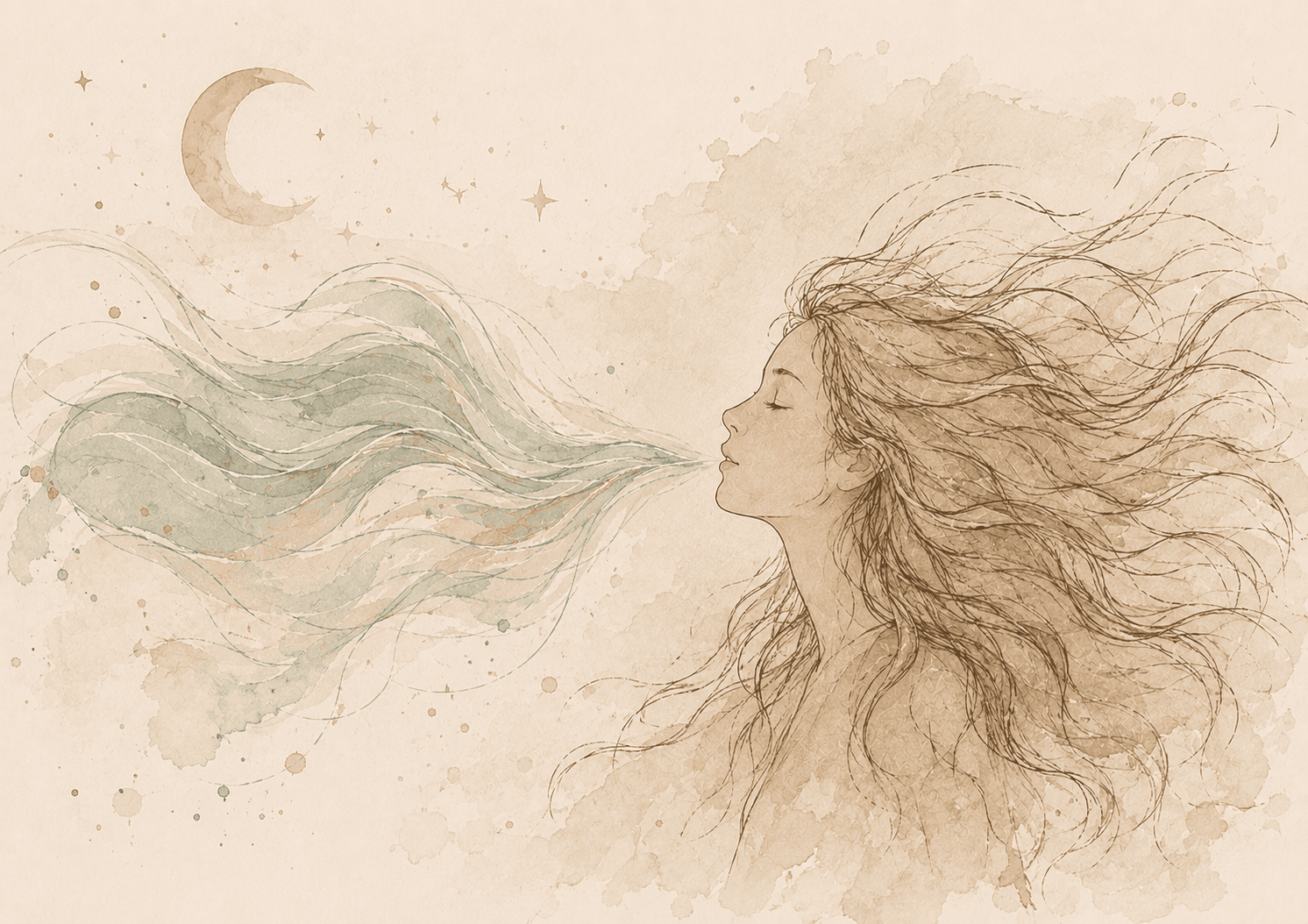
A gentle return to the body, to the breath, to yourself
How does your body breathe you?
Before anything else,
you don’t need to change your breath.
If it feels okay, you might begin by simply noticing it.
Maybe it’s shallow.
Maybe it’s held.
Maybe it’s moving freely.
However it is, it’s welcome.
Nothing here needs to be corrected.
The Breath, Before Life Shaped It
At the beginning of life, the breath often moves freely.
Continuous, soft, and in rhythm with the body.
There may be no effort.
No need to control.
Just a natural flow.
As we grow, life begins to shape us.
Experiences, environments, and relationships may leave their imprint.
Stress, fear, and moments of overwhelm can influence how the body organizes itself.
And the breath may adapt.
It may become shorter.
It may pause.
It may speed up.
Or it may be held in ways we are not consciously aware of.
These patterns may make sense in the context of what your system has experienced.
They can reflect intelligent responses of the nervous system.
At times, they may begin to feel limiting,
making it harder to feel settled, connected, or at ease.
Beneath these patterns,
a more natural rhythm may still be available.
One your body can reconnect with, gradually and safely.
What Is Conscious Connected Breathwork?
Conscious Connected Breathwork is a guided practice where the breath is invited into a more continuous, connected rhythm, without intentional pauses between the inhale and exhale.
This is always an invitation, never something that is forced.
At any point, you can slow the breath, pause, or return to your natural breathing rhythm.
Your body’s signals guide the process.
This way of breathing can influence how the nervous system responds to stress, emotion, and
internal states.
At the same time, it can open space for:
• a deeper awareness of the body
• access to emotions that may not be easily reached through thinking alone
• a more integrated connection between physical sensation and emotional experience
At times, you may notice physical sensations such as tingling, warmth, shifts in temperature, or lightness in the body.
These can be natural responses to changes in breathing and may settle as the body adjusts.
Rather than focusing on performance or doing it right,
the emphasis is on awareness, pacing, and integration.
If You’ve Felt Overwhelmed by Breathwork Before
Your experience may make sense.
Some forms of breathwork can feel intense or fast-paced,
especially when the body is not given enough time or support to adjust.
Here, intensity is not the goal.
We work with what your system can hold,
rather than pushing beyond it.
The breath can be adjusted at any time.
Slowing down, pausing, or stopping is always welcome.
This can allow the experience to unfold in a way that feels manageable,
rather than overwhelming.
Why This Work Matters
The breath is closely connected to the nervous system.
It can shift with stress, emotion, memory, and connection.
It also has the capacity to influence those states.
As the breath changes, the body can begin to respond differently.
These changes don’t need to be dramatic to be meaningful.
Over time, they may begin to shape how your system relates to everyday life.
You may begin to notice:
• catching yourself holding your breath during stress, and softening it
• feeling less reactive in situations that once felt overwhelming
• recovering more quickly after emotional activation
• a reduction in baseline anxiety or internal pressure
• less tension in areas like the jaw, chest, shoulders, or stomach
• sleeping more easily, or feeling more rested
• being able to stay present in conversations without shutting down or over-explaining
• feeling emotions without needing to avoid, suppress, or become consumed by them
• a greater sense of being grounded in your body, rather than in your thoughts
• noticing early signs of stress before they escalate
• less unconscious gripping, bracing, or over-efforting
• feeling more at ease slowing down or resting
• easier access to a fuller, more natural breath
• a growing sense of internal steadiness and support
For some, it may also feel like being able to remain with yourself
in moments where you would have previously disconnected.
Or sensing a kind of internal support that may not have been accessible before.
Over time, this can support a nervous system that becomes
more adaptable, more responsive, and less reactive.
Not through force,
but through repetition, awareness, and the body’s natural capacity to reorganize.
A Trauma-Informed, Nervous System Approach
This work is grounded in a trauma-informed understanding of the body and nervous system.
The pace can follow what feels manageable, rather than a fixed structure.
Experiences can be approached gradually, in ways that can be integrated.
There is ongoing choice in how you engage.
Your responses are respected as meaningful, not something to push through.
Many of the patterns we carry may develop over time, often early in life.
This work can meet those patterns with care,
supporting the body without overwhelming it.
How I Work
My work integrates breathwork with somatic awareness and relational support.
In sessions, we may include:
• Conscious Connected Breathwork
• awareness of physical sensations in the body
• grounding and regulation practices
• space for emotional processing, when it feels appropriate
This is a process I am trained to guide and support, moment by moment.
You are supported throughout the experience.
At times, this may include gentle guidance.
At times, simply being met in what is present.
At times, what can support change is not only the breath itself,
but the experience of not having to move through it on your own.
At times, your body may want to move, shift, or express through sound.
These can be natural ways the system releases and reorganizes, and are always welcome if they feel right for you.
At times, we may also include simple supportive elements such as:
• music that follows and supports the rhythm of the breath
• gentle somatic guidance or cues
• self-touch or grounding through contact with your body
• space for expression through sound, movement, or simple mark-making
• in some settings, supportive touch offered with clear consent
These are not techniques to perform,
but invitations to deepen awareness and connection in a way that may feel natural to you.
This relational element can allow the nervous system to experience not only self-regulation, but also co-regulation, where it can begin to settle and reorganize in connection.
After the breathing, there may be space to rest, integrate, and allow the experience to settle in your own time.
Ways to Work Together
1:1 Online Sessions
A personalized space where we work with your unique patterns, pace, and intentions.
Sessions are collaborative and can be shaped around what feels manageable for you.
Group Sessions (In-Person & Online)
Group sessions can offer a shared environment where individual and collective regulation can unfold.
There is no pressure to perform or share.
Participation is always at your own level of comfort.
Workshops, Corporate Trainings & Talks
I offer tailored experiences for:
• workshops and retreats
• corporate wellbeing trainings
• conferences and speaking engagements
• collaborative events
These sessions are designed to be clear, practical, and accessible, supporting people in understanding their nervous system and how they can begin to work with it in everyday life.
A Different Kind of Breathwork
This is not about pushing limits or creating intense experiences.
It is about working with the body in a way that can feel
supported, paced, and sustainable.
Change here is often gradual.
It may begin with something simple:
a breath that feels a little fuller,
a body that feels a little softer,
or a moment where you are able to stay, rather than leave yourself.
Over time, these moments can begin to build.
You Are Welcome Here
Whether you are familiar with this kind of work
or completely new to it,
you are welcome.
This space meets you where you are,
and works with your system, not against it.
If this feels like something your body is ready for,
you’re welcome to reach out.